How to prepare for a viva: a step-by-step guide for students
Last updated
A viva, or viva voce, is an oral examination where you explain and defend your own work: a final-year project, a dissertation, a thesis or a coursework assignment. It can feel more stressful than a written exam because you cannot plan every answer in advance. The good news is that a viva is about your own work, which you know better than anyone. This guide explains what examiners are looking for, how to know your project in depth, which questions to expect, how to practise and how to handle the questions you cannot answer.
What a viva is, and what examiners want
In a viva, one or more examiners ask you questions about work you have submitted. Depending on your course, it might last ten minutes or more than an hour, and it might be a short check on a coursework project or a long discussion of a thesis. Whatever the format, the examiners want to find out three things: did you do this work yourself, do you understand it, and can you explain and justify the decisions you made?
That means a viva is not mainly a test of memory. Examiners are not trying to catch you out on trivia. They want to see that you understand why your work is the way it is: why you chose this approach, what the alternatives were, what the limitations are and what you would do differently. A student who understands their work deeply can answer questions they have never heard before, because they can reason from that understanding.
Vivas also serve as an integrity check. Because the questions follow your answers, it is very hard to pass a viva on work you did not do or do not understand. That is why preparation should focus on understanding rather than memorising.
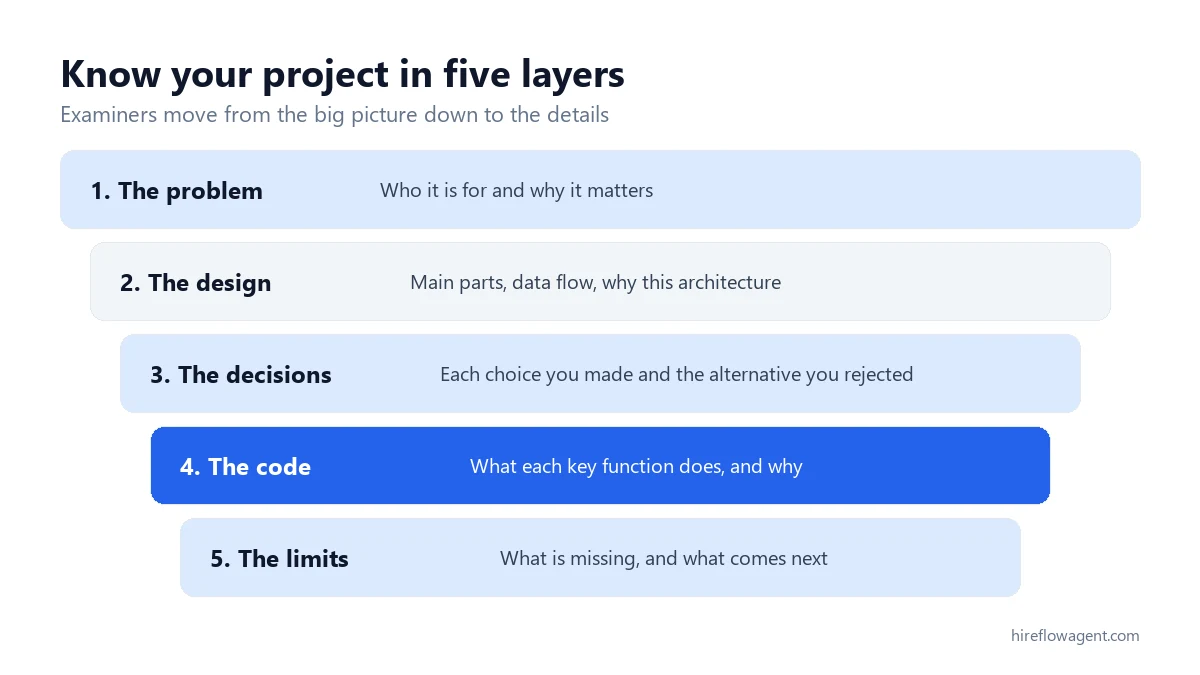
Know your project in five layers
Examiners usually start with the big picture and move towards the details, following your answers wherever they lead. A useful way to prepare is to make sure you can talk confidently at five levels: the problem, the design, the decisions, the code or method, and the limits.
The problem: who is your project for, what does it solve and why does that matter? The design: what are the main parts, how does information flow between them, and why did you structure it that way? The decisions: what choices did you make, and what did you reject? The code or method: can you explain any important part of what you built or did, line by line if asked? The limits: what does not work yet, what you would change, and what you would do with more time?
Go through each layer and say your answers aloud. Where you hesitate, that is where to revise.
Step 1: Reread your own work as an examiner would
Start by reading your report or thesis from beginning to end, slowly, as if you were the examiner seeing it for the first time. Keep a notebook beside you and write down every question that occurs to you: anything unclear, any claim that needs evidence, any decision that is not explained, any result that looks surprising.
These are very likely to be the examiners' questions too. Also note anything you now think is wrong or could be better. Finding weaknesses in your own work before the viva is a strength, not a problem: you can prepare a calm, honest explanation instead of being surprised.
If your project includes code, open the main files and read them too. Examiners often ask you to explain a particular function or why something is written a certain way, and it is easy to forget the details of code you wrote months ago.
Step 2: Explain your project in two minutes
Most vivas begin with an open question such as "Can you give us an overview of your project?" or "What did you set out to do?". Prepare a clear two-minute summary: the problem, your approach, the main thing you built or found, and what you learned or concluded.
Practise this summary until you can give it fluently without notes. A confident opening settles your nerves and gives the examiners a good first impression. It also steers the conversation: the parts you mention in your summary are likely to be the parts they ask about next.
- The problem and who it matters to (one or two sentences)
- Your approach, in plain words
- The main thing you built, found or showed
- One honest limitation and what you would do next
Step 3: Predict the questions
Although every viva is different, many questions come up again and again. Write down your answer to each of the following in a few bullet points, then practise saying them aloud.
Why did you choose this topic or problem?
Explain the motivation honestly: a gap you noticed, a real user need, an interest that grew from a course. Connect it to why the problem matters.
Why did you choose this approach, method or technology?
Name the alternatives you considered and give a reason for your choice, such as fit with the problem, your experience, time available or performance.
How does this part work?
Be ready to walk through the main components and any key function or algorithm in plain words, then in detail if asked.
How did you test or evaluate it?
Describe what you tested, how, and what the results showed, including what did not work.
What are the limitations of your work?
Name real limitations calmly. Examiners respect students who know the weaknesses of their own work.
What would you do differently or next?
Show that you have reflected: a design you would change, a feature you would add, a method you would use with more time.
What was your personal contribution?
In group work, be clear and specific about which parts you did, and be able to explain them in depth.
Step 4: Prepare for questions about your decisions
The questions that separate strong students from weak ones are usually "why" questions. "Why did you use this database?", "Why this algorithm rather than that one?", "Why did you design the interface this way?". These test whether you made deliberate decisions or simply copied an example.
For each major decision in your project, write down what you chose, at least one alternative you considered, and why you chose as you did. If some decisions were made for practical reasons, such as "it was what I knew" or "there was a tutorial for it", it is fine to say so honestly, and even better to add what you would choose now and why. Examiners are not expecting perfection; they are checking that you can think about trade-offs.
| Decision | What I chose | Alternative | Why |
|---|---|---|---|
| Database | PostgreSQL | MongoDB | My data had clear relationships, so tables and joins fitted better |
| Login | Email and password with hashing | Login with Google only | Some users had no Google account; I added hashing for security |
| Hosting | One small server | Serverless functions | Simpler to set up and debug within the project time |
Step 5: Practise out loud with follow-up questions
Reading your notes is not enough. In the viva you will have to explain things aloud, in your own words, while someone listens and asks follow-up questions. That is a different skill, and it only improves with practice. Ask a friend, classmate or family member to ask you questions from your list and, importantly, to follow up: "Why?", "What happens if...?", "Can you show me where that is in the code?".
Practise explaining technical ideas simply first, then in more detail. Examiners often start with a broad question and then dig deeper, so you need both levels. Record yourself if you can, and notice where you hesitate or ramble; those are the areas to revise.
An AI practice viva can also help, especially if you cannot find someone to practise with. Some tools read your report and code and ask questions about your own project, following up on your answers the way an examiner would.
Step 6: Know the format and the logistics
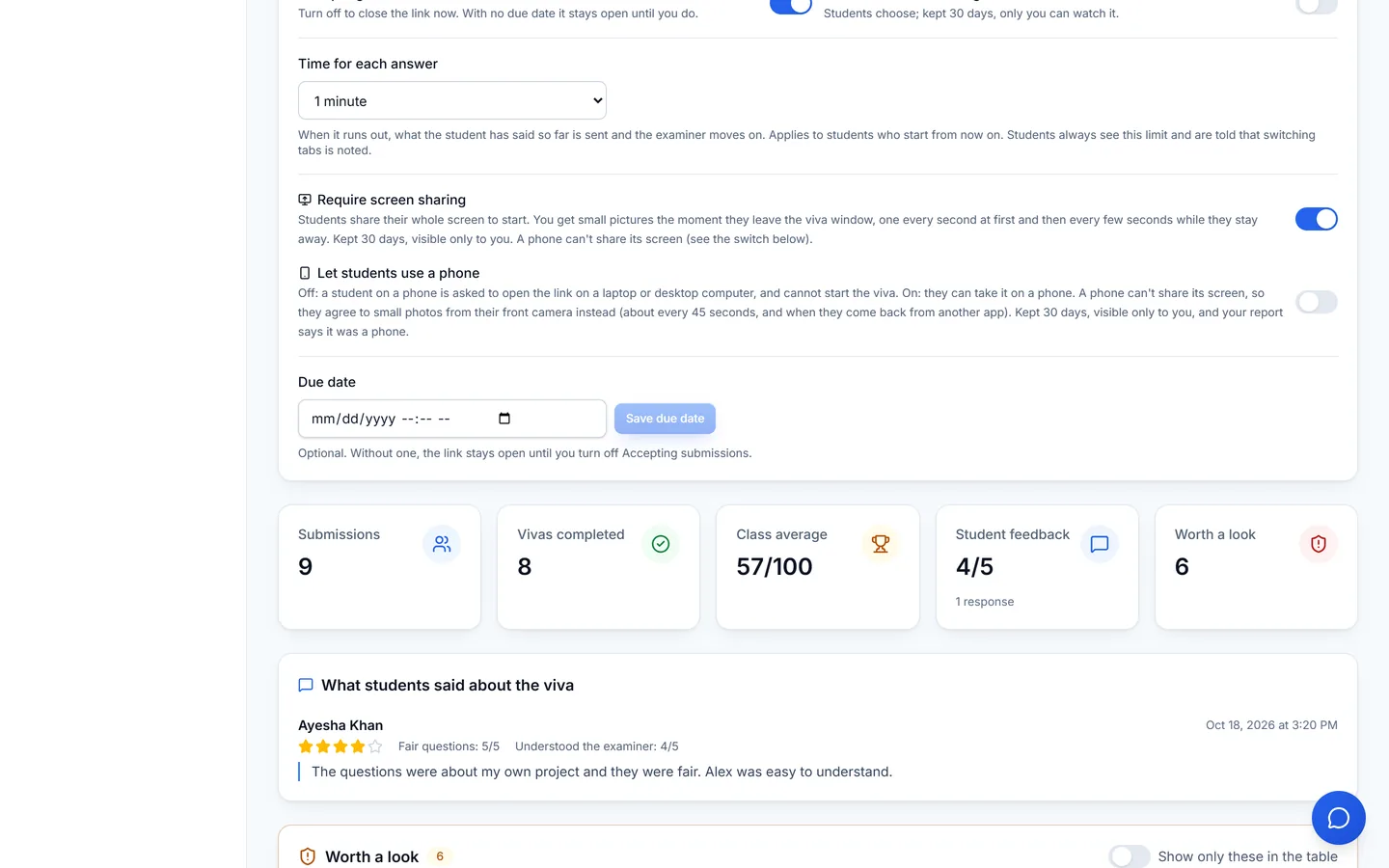
Find out as much as you can about the format in advance: how long the viva lasts, how many examiners there will be, whether you will give a presentation or demonstration first, whether you can bring notes or your report, and whether it is in person or online. Ask your supervisor or teacher; they want you to do well.
If you will demonstrate a working system, rehearse the demonstration several times and have a backup plan, such as screenshots or a recorded video, in case something fails on the day. For online vivas, test your camera, microphone, internet connection and screen sharing in advance, and close anything that might send notifications.
- How long is the viva, and how many examiners?
- Is there a presentation or demonstration?
- Can you bring notes, your report or your laptop?
- Is it in person or online, and on which platform?
- What happens after the viva, and when will you hear the result?
Step 7: Handle questions you cannot answer
Almost every viva includes at least one question you cannot answer straight away. That is normal, and examiners expect it. What matters is how you respond. Do not panic, and do not invent an answer; examiners can usually tell, and a confident wrong answer does more damage than an honest "I am not sure".
Take a moment to think. If you partly know the answer, say what you do know and reason towards the rest aloud. If you genuinely do not know, say so honestly, and explain how you would find out or what you think the answer might be. If you do not understand the question, ask the examiner to rephrase it. All of these show the kind of thinking examiners are looking for.
- "Let me think about that for a moment."
- "I am not completely sure, but my understanding is..."
- "I did not test that case, but I would expect... because..."
- "Could you rephrase the question? I want to make sure I answer what you are asking."
- "That is a limitation of my project; with more time I would..."
Step 8: On the day
Get a good night's sleep and arrive early, or log in early for an online viva. Bring a copy of your report, a notebook and a pen if allowed. Before you go in, take a few slow breaths; nerves are normal, and examiners know you are nervous.
During the viva, listen to the whole question before answering, and keep your answers focused. It is fine to pause, to ask for a question to be repeated, and to draw a quick diagram if it helps you explain. Speak to the examiners as you would to interested colleagues: you are the expert on your project, and they want to understand it.
If the viva is held with an AI examiner, as some courses now do, the same principles apply. Answer clearly in your own words, explain your reasoning, and be honest about what you do not know. The questions will follow your answers in the same way.
A seven-day viva preparation plan
If you have a week, spread the work out like this. Each day takes one to two hours.
| Day | Focus | What to finish |
|---|---|---|
| 1 | Reread | Report and code read as an examiner; list of questions and weak points |
| 2 | Summary | Two-minute overview practised aloud until fluent |
| 3 | Decisions | Decision log: each choice, the alternative and the reason |
| 4 | Questions | Bullet-point answers to the common viva questions |
| 5 | Practice | Practice viva with someone who asks follow-up questions |
| 6 | Fix | Weak areas revised; demonstration rehearsed with a backup |
| 7 | Rest | Light review, logistics checked, early night |
Different kinds of viva
The word viva covers several kinds of oral examination, and preparation differs a little for each. A project viva, common for final-year computing and engineering projects, focuses on what you built: the design, the code and the testing. Expect to explain parts of your system in detail and possibly demonstrate it. A dissertation or thesis viva focuses on your research: your question, your methods, your evidence and how your conclusions follow from it. Expect detailed questions about your literature, methodology and the limits of your findings.
A coursework viva or authenticity check is usually shorter and is used to confirm that submitted work is your own. The questions often ask you to explain specific parts of what you handed in. An oral exam, used in some subjects instead of or alongside written exams, tests your knowledge of a topic more broadly rather than a single piece of work.
Whatever kind of viva you face, the same core preparation applies: know your work, be able to explain your reasoning, and practise speaking about it aloud.
How to explain your code in a viva
If your project involves software, examiners will often point to a part of your code and ask you to explain it. Many students find this harder than they expect, because they wrote the code months earlier or relied on examples from tutorials. Prepare by choosing the five or six most important files or functions and making sure you can explain each one at three levels: what it does in one sentence, how it works step by step, and why you wrote it that way.
When explaining, start from the purpose before the detail: "This function checks the user's password; it takes the password they typed, hashes it, and compares it with the stored hash." Then go into detail if asked. If you used code from a tutorial or a library, say so honestly and show that you understand what it does. Examiners are much more concerned with understanding than with whether every line was written from scratch.
Be ready to explain how you tested your code and how you would find a bug in it. Questions such as "What happens if the user enters nothing?" or "What happens if two people do this at the same time?" are common, because they show whether you have thought about edge cases.
Vivas for group projects
In a group project viva, examiners need to assess each person individually, so expect questions that separate your contribution from the team's. Be ready to say clearly which parts you designed, built or wrote, and to explain those parts in depth. It is fine, and honest, to say that a teammate built another part; you should still understand roughly how it works and how it connects to yours.
Before the viva, agree with your group who will answer questions about which parts, and make sure everyone can describe the overall system in the same way. Contradicting each other about how the project works is one of the most common problems in group vivas. Avoid speaking over teammates or answering questions directed at them, unless you are invited to add something.
Vivas outside computing
Vivas are not only for software projects. In business, data, design, health and social science subjects, the same principles apply, with different details. For a data project, expect questions about where your data came from, how you cleaned it, why you chose your methods and how confident you are in your results. For a design project, expect questions about your users, the alternatives you sketched and the feedback that changed your design. For a research dissertation, expect questions about your sources, your method and whether your conclusions are supported by your evidence.
In every subject, the key question is the same: can you explain and justify the choices you made? Prepare your decision log, practise explaining your work in plain words, and be honest about its limitations.
After the viva
When the viva ends, write down the questions you were asked and how you answered them while they are fresh. If you are asked to make corrections or changes to your work, which is common for dissertations and theses, make sure you understand exactly what is required and by when; ask the examiners or your supervisor to confirm anything that is unclear.
Whatever the result, the experience is valuable. Explaining and defending your own work under questioning is exactly what you will do in job interviews, client meetings and presentations. Many employers ask candidates to talk through a project in an interview, and the preparation you did for your viva, especially your decision log and your two-minute summary, can be reused almost directly.
If you felt the viva went badly, remember that examiners judge your understanding across the whole conversation, not on a single answer. One weak moment rarely decides the outcome.
Common viva mistakes
Most viva problems come from a few habits that are easy to fix with preparation.
- Not rereading your own work, so you forget details you wrote months ago
- Memorising answers instead of understanding the reasons behind your decisions
- Becoming defensive when examiners point out a weakness
- Bluffing instead of admitting you do not know
- Being vague about your own contribution in group work
- Not rehearsing a live demonstration, or having no backup plan
- Rushing answers instead of taking a moment to think
Practise this out loud
Take a live AI mock interview with questions built from your resume and the job description, then get a clear feedback report.
Start a mock interviewFrequently asked questions
- What is a viva?
- A viva, short for viva voce, is an oral examination in which you explain and defend your own work, such as a project, dissertation or thesis, by answering examiners' questions.
- How long should I prepare for a viva?
- About a week of regular short sessions works well for most student projects: rereading, summarising, preparing decisions and questions, and practising aloud.
- What if I cannot answer a question in my viva?
- Pause, think, share what you do know and reason aloud. If you do not know, say so honestly and explain how you would find out. Do not invent an answer.
- Can I bring notes to a viva?
- It depends on your institution and course. Many allow a copy of your report; ask your supervisor in advance.
- How do examiners decide the result of a viva?
- They judge whether the work is your own, whether you understand it and whether you can explain and justify your decisions, usually against a marking rubric.