How to answer "Tell me about yourself" in an interview
Last updated
"Tell me about yourself" is usually the first question in an interview, and it sets the tone for everything that follows. It sounds like the easiest question of all, which is exactly why so many people answer it badly: they ramble, recite their resume or tell their life story. A strong answer is short, relevant to the job and ends by connecting to the role. This guide explains what the interviewer is really asking, gives you a simple structure, shows example answers for different situations, and explains how to practise until it sounds natural.
What the interviewer is really asking
The interviewer is not interested in your full biography. They are asking: in about a minute, which parts of your background matter for this job, and can you explain them clearly? The question also works as a warm-up. It gives you a chance to settle in, and it gives the interviewer material for follow-up questions.
That second point is important. Whatever you mention in your answer is likely to be picked up later: "You mentioned a reporting tool you built; tell me more about that." So your answer is not just a summary; it is a way of steering the interview towards your strongest material. Choose what you mention deliberately.
Interviewers also use this answer to form a first impression of how you communicate. A clear, structured, confident minute tells them a lot before you have answered a single technical question.
The present, past, future structure
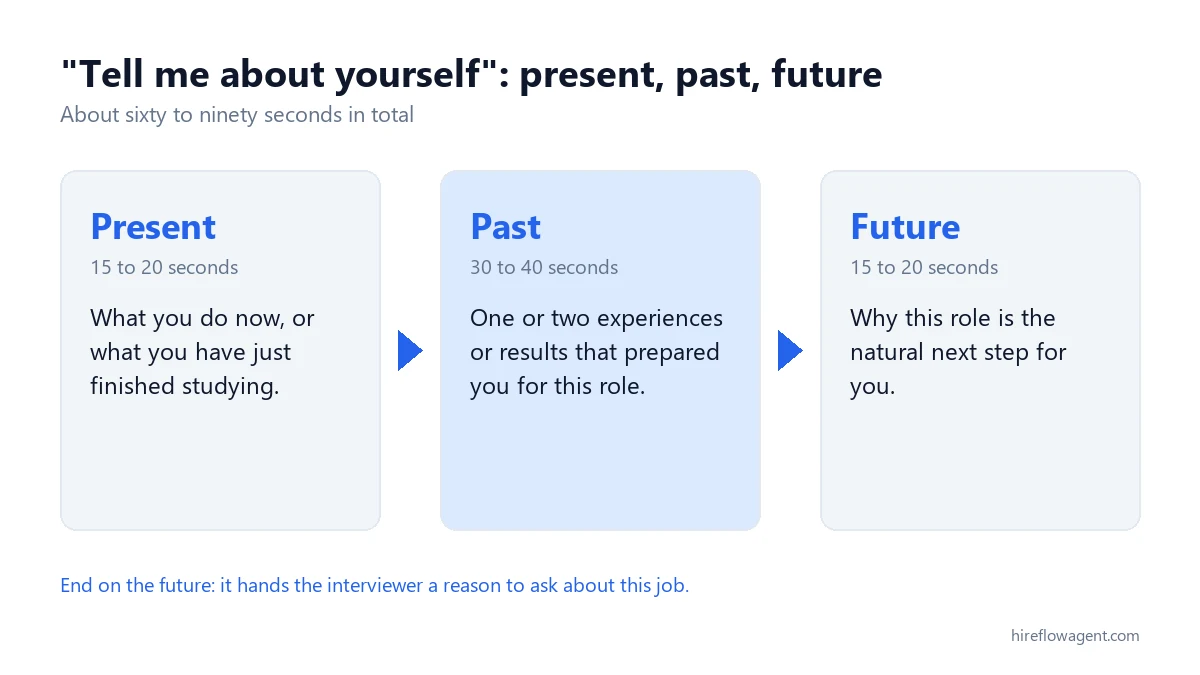
The most reliable structure has three parts. Present: say what you do now, or what you have just finished studying, in one or two sentences. Past: mention one or two experiences or achievements that prepared you for this role. Future: explain why this role is the logical next step for you.
This order works because it starts where the interviewer's curiosity is (who are you now?), gives evidence (what have you done?) and finishes with the thing they care about most (why are you here?). Ending on the future hands the interviewer a natural next question about the role, rather than leaving the answer hanging.
Aim for sixty to ninety seconds in total. That is roughly 150 to 220 spoken words. If your answer takes three minutes, you are almost certainly including details that belong later in the interview, if at all.
Step 1: Choose what to include
Before you write anything, read the job advertisement again and pick the two or three things it cares about most. Then look at your experience and find the items that match those needs best. These are the only things that belong in the "past" part of your answer.
This is the main difference between a weak and a strong answer. A weak answer covers everything in chronological order. A strong answer is selective: it mentions the two experiences most relevant to this job and leaves the rest for the resume. If you are applying for different kinds of roles, your answer should change for each one.
Include a concrete result where you can: a project you finished, a number you improved, a problem you solved. One specific result is far more memorable than a list of responsibilities.
- Read the job advertisement and note its top two or three needs
- Pick the experiences that best match those needs
- Find one concrete result to mention
- Decide what you will leave out, deliberately
Step 2: Write it as bullet points, not a script
Write three or four bullet points, not full sentences: your current situation, one or two key experiences with a result, and why this role. Then practise speaking from the bullet points. A script learned word for word tends to sound flat and falls apart if you lose your place; bullet points let you speak naturally and adapt.
Keep the language simple and active. "I built", "I led", "I improved" are stronger than "I was involved in" or "I had the opportunity to". Avoid jargon unless the interviewer will clearly understand it.
Example: a fresh graduate
"I have just finished my computer science degree. For my final-year project I built a web platform with two classmates, where I was responsible for the backend and the database. The part I am proudest of is the testing: I wrote automated tests that caught several bugs before our demo, and the system ran without problems in front of the examiners. Alongside my studies I tutored first-year students in programming, which taught me to explain technical ideas simply. I enjoy the whole cycle from idea to a running product, and I am looking for a junior developer role where I can keep learning from experienced engineers, which is why this position appealed to me."
Why it works: it starts with the present, picks one project and one specific achievement rather than listing every module, adds one relevant extra experience, and finishes by connecting to the role. It takes about seventy seconds to say.
Example: an experienced candidate
"I am a backend developer with four years of experience building web services for logistics companies. Most recently I led the redesign of our order reporting, which cut report times from several minutes to a few seconds and meant the operations team could check stock levels during the day instead of overnight. Before that I worked on payment integrations, where I learned how much care financial data needs. I am now looking for a role on a larger product team, where I can work on systems used by many more people, which is what drew me to this position."
Why it works: one sentence sets the scene, one achievement has a clear result and explains why it mattered to the business, one earlier experience adds depth, and the ending explains the move.
Example: a career changer
"For the past five years I have worked in customer support for an online retailer, where I became the person the team came to for anything involving our data. I started building spreadsheets to track recurring problems, then taught myself SQL to pull the data directly, and my reports helped the company fix the three issues behind most of our complaints. Last year I completed a data analysis course to make that skill formal. I want to move into a data analyst role full time, and this position, which works closely with customer teams, feels like the right bridge between what I know and what I want to do."
Why it works: a career changer needs to explain the link between the old field and the new one. This answer turns the change into a natural progression rather than a leap, and uses a real result to show the new skill in action.
Example: an internship applicant
"I am a second-year business student with a strong interest in marketing analytics. Last semester I ran the social media accounts for our university's entrepreneurship society and grew our event sign-ups by tracking which posts actually led to registrations and doing more of those. I also completed a short course on spreadsheets and data visualisation. I am applying for this internship because I want to see how a real marketing team uses data to make decisions, and your team's work on campaign measurement is exactly that."
Adapt the answer to the type of interview
The same structure works in every format, but the emphasis should change. In a short phone screen with a recruiter, keep it to about a minute and make sure the key requirements of the job are clearly covered, because the recruiter is often checking a list. In an interview with the hiring manager, you can add a little more depth about the work itself, since they understand the details and will want to hear how you approach problems.
In a panel interview, remember that different people care about different things: a technical lead, an HR partner and a manager may all be listening. A balanced answer that touches on your skills, how you work with people and why you want the role gives each of them something. In a video or AI-led interview, where you may have a time limit and no visual feedback, structure matters even more. Say the three parts clearly, keep within the time, and finish with a firm closing sentence so the recording does not trail off.
In a technical interview, the interviewer may want a shorter introduction so they can move to problem solving. If they say "Give me a quick overview", take that literally: thirty to forty-five seconds, with the one technical experience that matters most.
One person, two different answers
To see how selective a strong answer should be, imagine a graduate who studied computer science, built a data dashboard in their final-year project and worked part-time in a shop. Applying for a data analyst role, they would lead with the dashboard project, mention the SQL and visualisation work, and perhaps add that working in the shop taught them how sales data looks from the shop floor. Applying for a customer-facing technical support role, they would lead with the shop experience and dealing with customers, then mention that their degree and project give them the technical background to solve problems properly.
The facts are the same. The order, the emphasis and the closing sentence change. That is what interviewers mean when they say an answer was "relevant": it was built for their job, not for every job.
Be ready for the follow-up questions it triggers
Because your answer sets the agenda, expect the interviewer to pick up on what you mentioned. If you name a project, be ready to explain your role, the main challenge and what you would do differently. If you mention a result, be ready to explain how you measured it. If you say why you want this role, be ready for "Why now?" or "What else are you applying for?".
Before the interview, read your answer back and underline every noun that could become a question: each project, tool, employer, result and goal. Then make sure you can talk about each one for a minute or two. This is one of the most effective ways to prepare, because it turns your opening answer into a map of the conversation you want to have.
- "Tell me more about that project. What was your part?"
- "How did you measure that improvement?"
- "Why are you looking to move now?"
- "What did you enjoy least about that role?"
- "What do you know about our team?"
Example: returning after a career break
"I am an accountant with six years of experience in small and medium-sized firms, mainly preparing monthly management accounts and year-end files. I took two years away from work to care for a family member, and during that time I kept my skills current by completing a course on cloud accounting software and helping a local charity with its bookkeeping. Before my break I led the move of a client's records to a new accounting system, which halved the time their month-end took. I am ready to return full time, and this role, with its focus on management reporting for growing businesses, matches exactly what I did best."
Why it works: it mentions the break briefly and without apology, shows how skills were kept up, highlights a strong result from before, and ends firmly on the role. Interviewers generally care far more about what you can do now than about the gap itself.
Example: a manager or senior candidate
"I lead a team of eight support engineers at a software company, where I have been for five years, starting as an engineer myself. Over the last two years we reduced the average time to resolve a customer issue by about a third, mainly by building a shared knowledge base and changing how we hand over cases between shifts. I also hired and trained four of the current team. I am looking for a role where I can lead a larger function and work more closely with product teams on fixing problems at the source, which is why this head of support position interests me."
For senior roles, interviewers want to hear about scope (team size, budget, responsibility), outcomes (what changed because of you) and how you work through others. Keep personal technical detail short unless the role is hands-on.
What the interviewer remembers afterwards
After a day of interviews, interviewers rarely remember exact words. They remember a few things: a clear sense of who you are professionally, one or two concrete achievements, and whether you seemed to want this particular job. Your opening answer has a large influence on all three, because it is the first thing they hear and the frame through which they hear everything else.
So when you choose what to include, ask yourself a simple question: if the interviewer remembers only one thing from this answer, what do I want it to be? Make sure that one thing is stated clearly, with a specific example, rather than buried in the middle of a long list. A memorable, specific answer gives the interviewer something to write in their notes and something to mention when they discuss candidates with colleagues later.
A final checklist
Before the interview, check your answer against this list. If it passes every point, you are ready.
- It follows present, past, future
- It takes sixty to ninety seconds when spoken aloud
- It mentions one or two experiences chosen for this job
- It includes at least one concrete result
- It ends with a clear link to this role
- You can talk for a minute about everything it mentions
- You have practised it aloud at least five times
Mistakes to avoid
Most weak answers fall into a few predictable traps. The most common is reciting the resume in order, which is both boring and unnecessary, because the interviewer has the resume in front of them. The second is starting too far back, with school or childhood, so that the relevant part arrives after two minutes. The third is ending without any link to the role, so the answer just stops.
Other mistakes include sharing personal information that has nothing to do with work, sounding negative about a current or previous employer, using vague phrases with no examples, and reading from notes in a flat voice.
- Reciting your resume line by line
- Starting with school, childhood or where you grew up
- Listing responsibilities without any result
- Speaking for more than two minutes
- Criticising a current or former employer
- Ending without connecting to the role
Variations of the question and how to adapt
The same question appears in several forms: "Walk me through your resume", "Tell me a bit about your background", "Introduce yourself" or "How would you describe yourself?". The structure still works for all of them. "Walk me through your resume" invites a little more chronological detail, so you can mention each role briefly, but you should still highlight the parts that matter most for this job and still end on why you are here.
"How would you describe yourself?" asks for qualities rather than history. Pick two or three qualities that matter for the job and support each with a very short example, then link to the role. The principle is the same: be selective, be specific, connect to the job.
How to deliver it with confidence
Because this is usually the first answer, delivery matters a great deal. Speak a little slower than feels natural, especially at the start, when nerves tend to speed you up. Make eye contact (or look at the camera in an online interview), and smile when it fits. A short pause before you begin is perfectly fine.
End clearly. Many people trail off because they are not sure when to stop. Finishing with a clear sentence about why you want this role signals that you have finished, and hands the conversation back to the interviewer.
How to practise until it sounds natural
Say your answer aloud at least five times before the interview, ideally on different days. Time each attempt: if you are over ninety seconds, cut something from the past section. Record yourself on your phone and listen back once, paying attention to filler words, speed and whether the ending is clear.
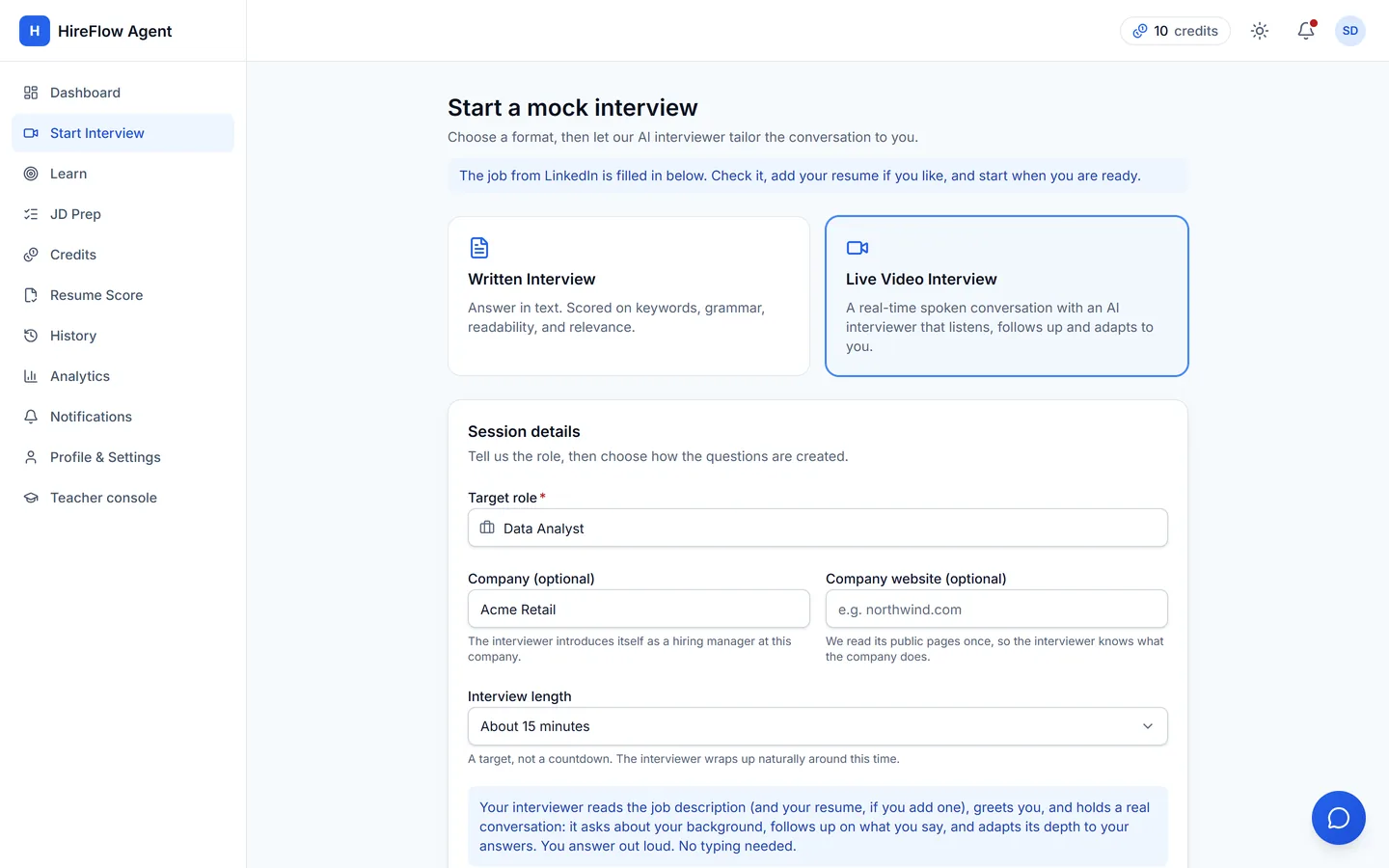
Then practise it in a realistic setting, where someone asks the question and follows up on what you said. That is the true test, because the follow-up questions show whether you chose the right things to mention. A friend, a mentor or an AI mock interview can do this. In an AI mock interview built from your resume and the job description, the opening question is usually this one, so you get to practise the answer and then the follow-ups it leads to.
A template you can fill in
Use this as a starting point and then put it into your own words. Do not memorise it; use it to make sure you have all three parts.
| Part | Prompt | Your notes |
|---|---|---|
| Present | I am a ... who ... / I have just finished ... | One or two sentences |
| Past (1) | Most recently I ..., which resulted in ... | Your most relevant experience and its result |
| Past (2) | Before that I ..., where I learned ... | Optional second experience |
| Future | I am now looking for ... which is why this role ... | Link to this job specifically |
Practise this out loud
Take a live AI mock interview with questions built from your resume and the job description, then get a clear feedback report.
Start a mock interviewFrequently asked questions
- How long should my answer to "tell me about yourself" be?
- About sixty to ninety seconds, which is roughly 150 to 220 spoken words. Rarely more than two minutes.
- Should I mention personal hobbies?
- Only briefly, and only if they relate to the job or show a relevant quality. Keep the focus on your professional story.
- Is it okay to use the same answer for every interview?
- Keep the structure, but change the experiences you highlight to match each job. The best answer for one role is rarely the best for another.
- What if I have no work experience?
- Use projects, studies, volunteering, part-time jobs or student societies. Focus on what you did and achieved, and end with why the role fits.
- Should I memorise my answer?
- Memorise the structure and the key points, not the exact words. Practise from bullet points so it sounds like conversation, not a recitation.