The STAR method for interview answers, with examples
Last updated
The STAR method is the standard way to answer behavioural interview questions, the ones that start with "Tell me about a time when...". It gives every answer a clear shape, stops you from rambling and makes sure every story ends with a result. STAR stands for Situation, Task, Action and Result. This guide explains each part, shows how much time to spend on each, gives complete worked examples for the most common question types, lists the mistakes that weaken STAR answers and explains how to build a bank of stories you can adapt in any interview.
Why interviewers ask behavioural questions
Behavioural questions are based on a simple idea: the best guide to how someone will behave in future is how they have behaved in the past. Instead of asking "Are you good under pressure?", which anyone can answer with "Yes", the interviewer asks "Tell me about a time you worked under pressure" and listens to what you actually did.
Many organisations use structured interviews, where every candidate is asked the same behavioural questions and each answer is scored against the skills the role needs, such as teamwork, problem solving or communication. In that setting, a clear story with specific actions and a result is what earns a high score. A vague or hypothetical answer, however confident, gives the interviewer very little to write down.
What each letter means
Situation: set the scene in one or two sentences. Where were you, when, and what was going on? Give just enough context for the story to make sense.
Task: explain what you were responsible for, or what needed to be achieved. This separates your role from everyone else's and tells the interviewer what success looked like.
Action: describe what you personally did, step by step. This is the heart of the answer and should take the most time. Explain your reasoning as well as your actions: why you chose one approach over another.
Result: say what happened, ideally with a number or a concrete outcome, and what you learned. A story without a result feels unfinished, and the lesson shows that you reflect on your experience.
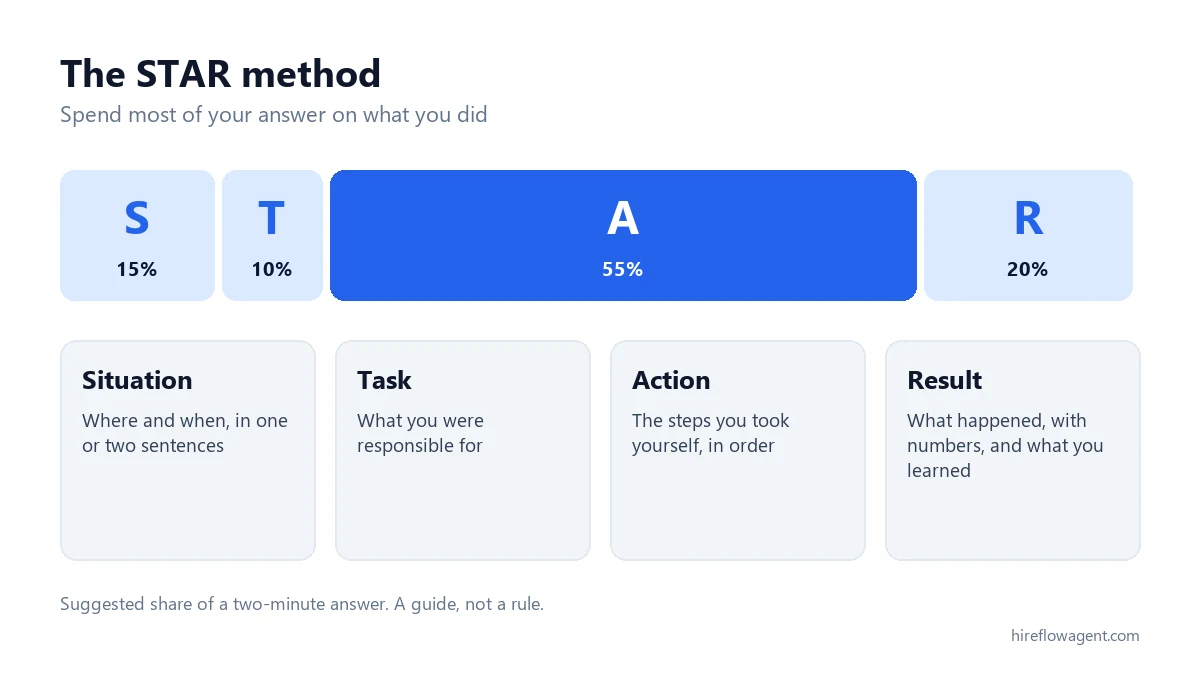
How long each part should take
Most STAR answers should take between one and two minutes. Within that, the action should take about half the time. A useful rough split is a sentence or two for the situation, a sentence for the task, several sentences for the action and two or three sentences for the result and the lesson.
The most common timing mistake is the opposite: a long, detailed situation, a short action and no result at all. Interviewers already understand that projects have deadlines and teams have problems. What they cannot guess is what you did, so that is where your time should go.
Worked example: a tight deadline
Question: "Tell me about a time you had to meet a tight deadline."
Situation: "In my final year, our project demo was moved forward by two weeks because the department changed the exam schedule."
Task: "I was responsible for the database and the login system, which every other part of the project depended on, so if I was late, everyone was late."
Action: "First I listed every remaining task and marked which ones the demo actually needed. Two features, password reset and an admin dashboard, were nice to have but not essential, so I proposed dropping them for the demo and my teammates agreed. Then I broke the remaining work into daily goals and tested each part as soon as I finished it, so I would not discover problems at the end. I also shared a short progress update with the team every evening, so they could plan their parts around mine."
Result: "We demonstrated a stable version on the new date, and our supervisor commented on how reliable it was. We added the two dropped features in the following week. The lesson I took away is that cutting scope early is better than trying to do everything quickly and doing it badly."
Worked example: a disagreement in a team
Question: "Tell me about a time you disagreed with a colleague."
Situation: "During a group project, one teammate wanted to switch to a new framework halfway through, because he had read that it was faster."
Task: "I was coordinating the plan, and I was worried that switching would put our deadline at risk."
Action: "Rather than arguing in the group chat, I suggested we meet and each write down the benefits, the risks and an honest time estimate. When we compared them, it was clear the switch would take at least two weeks we did not have. I suggested a compromise: keep our current setup for the deadline, and let him rebuild one small page with the new framework so we could judge it properly."
Result: "We met the deadline, and the trial page showed that the new framework really was easier for some parts, so we used it in the next phase. I learned that writing a disagreement down and comparing it calmly is more useful than debating it."
Worked example: a mistake or failure
Question: "Tell me about a time you made a mistake."
Situation: "In my internship I was asked to update a report that the sales team used every Monday."
Task: "I needed to change how one figure was calculated, and the report had to be ready by Monday morning."
Action: "I made the change and checked that the new figure looked right, but I did not check the other figures that depended on it. On Monday a sales manager noticed that a regional total was wrong. I told my manager straight away, found the cause within an hour, corrected the report and sent a short note to the sales team explaining what had happened and that the numbers were now fixed. Afterwards I wrote a simple checklist of the figures to compare before and after any change."
Result: "The corrected report went out the same morning, and nobody made a decision based on the wrong number. I have used that checklist ever since, and my manager later asked me to share it with the rest of the team. The lesson was that checking what a change affects matters as much as checking the change itself."
Worked example: leadership without a title
Question: "Tell me about a time you showed leadership."
Situation: "Our university society was organising its first large event, and three weeks before, nobody was clearly in charge of registrations."
Task: "I was not on the committee, but I volunteered to take over registrations because I could see it was going to cause problems."
Action: "I set up a simple online form, agreed with the committee who would check it each day, and wrote a short message template for confirming places. When we reached capacity a week early, I suggested a waiting list instead of closing registrations, and organised two volunteers to contact people on it as places came free."
Result: "Registration ran smoothly, every place was filled, and the committee asked me to join for the following year. I learned that leadership often means noticing a gap and taking responsibility for it, even without a title."
Worked example: learning something quickly
Question: "Tell me about a time you had to learn something new quickly."
Situation: "In my internship, the team decided to move its reports from spreadsheets to a business intelligence tool, two weeks before the quarterly review."
Task: "I had never used the tool, but I was asked to rebuild the three main sales reports in it before the review."
Action: "I spent the first evening working through the official beginner tutorials, then rebuilt the simplest report first, so I learned the basics on something low-risk. When I got stuck on a calculation, I wrote down exactly what I had tried and asked a colleague who had used the tool before; she showed me the right function in ten minutes. I kept a short list of what I learned, so I would not have to look the same things up twice, and I checked every figure against the old spreadsheet before moving on."
Result: "All three reports were ready two days before the review, and the figures matched the spreadsheets exactly. My list became the starting guide for two other people who moved to the tool after me. I learned that starting small and asking specific questions makes learning much faster."
Behavioural questions you can answer with STAR
Behavioural questions are usually linked to a particular skill. If you know which skill a question is testing, you can pick the right story and emphasise the right actions. Here are common questions grouped by the skill behind them.
| Skill | Typical questions |
|---|---|
| Teamwork | A time you worked in a team; a time a teammate was not doing their part |
| Conflict | A time you disagreed with a colleague or manager; a time you handled a difficult customer |
| Problem solving | A difficult problem you solved; a time you found the cause of something going wrong |
| Pressure | A tight deadline; juggling several priorities at once |
| Learning | Something you learned quickly; adapting to a change you did not choose |
| Leadership | Leading a team or project; persuading someone without authority |
| Integrity | A mistake you made; a time you had to say no or deliver bad news |
Worked example: a difficult customer
Question: "Tell me about a time you dealt with a difficult customer."
Situation: "I worked weekends at a phone shop while studying. One afternoon a customer came in very angry because his repaired phone had stopped working again after two days."
Task: "I was the only staff member on the counter, and I needed to calm the situation and find a fair solution without breaking the shop's repair policy."
Action: "I let him explain the whole problem without interrupting, then repeated it back so he knew I had understood. I checked the repair record and saw the same part had been replaced, which suggested a faulty part rather than misuse. I explained that I could not promise a refund myself, but I could book an urgent re-repair under the warranty and lend him a spare phone in the meantime. I wrote everything down and called the manager to confirm before he left."
Result: "He left calm, with a loan phone and a repair date, and the phone was fixed under warranty two days later. He came back the following month to buy an accessory and asked for me by name. I learned that most angry customers mainly want to be heard and to see a clear next step."
Notice how the action explains both what was done and why, and how the result includes a concrete outcome and a lesson. That is what makes a customer story convincing.
Variations of STAR you may hear about
Several similar frameworks exist, and they all share the same idea: give context briefly, focus on your actions, and finish with an outcome. CAR (Context, Action, Result) simply merges the situation and the task, which suits short answers. SOAR (Situation, Obstacle, Action, Result) puts extra emphasis on the difficulty you faced, which can work well for problem-solving questions. STARL or STAR-L adds Learning as a separate final step, making explicit what you took away from the experience.
You do not need to learn them all. If you use STAR and always finish with what you learned, you are effectively using STARL, which is what most interviewers want to hear. Choose one structure and practise it until it becomes natural, rather than switching between frameworks.
Handling follow-up questions on your STAR stories
A good interviewer rarely accepts a STAR answer and moves on. They probe: "Why did you decide to drop those features rather than ask for more time?", "What did your supervisor think?", "What would you do differently now?", "What was the hardest part for you personally?". These follow-ups check that the story is real and that you understand your own decisions.
Prepare for them by asking yourself the same questions about each story in your bank. For every action, know why you chose it and what the alternative was. For every result, know how you know it happened. And for every story, have an honest answer to "What would you do differently?". Interviewers trust candidates who can admit what they would change much more than candidates whose every story is perfect.
- Why did you choose that approach?
- What alternatives did you consider?
- How did you know it worked?
- What did other people think of your decision?
- What would you do differently next time?
Common STAR mistakes
Knowing the structure is not enough; most weak STAR answers have the right parts in the wrong proportions. The biggest problem is too much situation and too little action. The second is saying "we" throughout, so the interviewer cannot tell what you did. The third is forgetting the result, or ending with "and it went well" without saying how or why.
Other mistakes include choosing a story that does not actually answer the question, inventing a hypothetical answer ("I would...") instead of telling a real story, and picking an example so minor that it says little about you.
- Spending most of the time on the background
- Saying "we" so your own actions are hidden
- Ending without a clear result or lesson
- Giving a hypothetical answer instead of a real story
- Choosing a story that does not match the question
- Picking an example that is too trivial to show anything
Make your results specific
Results are where many otherwise good answers fall flat. "It went well" or "the client was happy" tells the interviewer very little. Specific results are much more convincing: a deadline met, a number improved, a problem that stopped happening, praise from a named person, a process that others adopted.
You do not need impressive numbers. "We cut the time it took to produce the report from a day to an hour" or "The same error did not happen again in the next six months" are perfectly good results. If you genuinely do not have a measurable result, describe the concrete outcome and the lesson instead. Never invent numbers; follow-up questions tend to expose them.
Build a STAR story bank
You cannot prepare a separate story for every possible question, but you do not need to. Six well-chosen stories cover the large majority of behavioural questions, because each story can be reshaped. A story about rescuing a late project can answer questions about deadlines, prioritising, teamwork, pressure and problem solving, depending on which part you emphasise.
Choose stories that cover a hard problem you solved, working in a team, a mistake or failure, leading or persuading others, learning something quickly and handling pressure. Write each one in four short paragraphs, then practise telling it aloud until you can do it in under two minutes without notes.
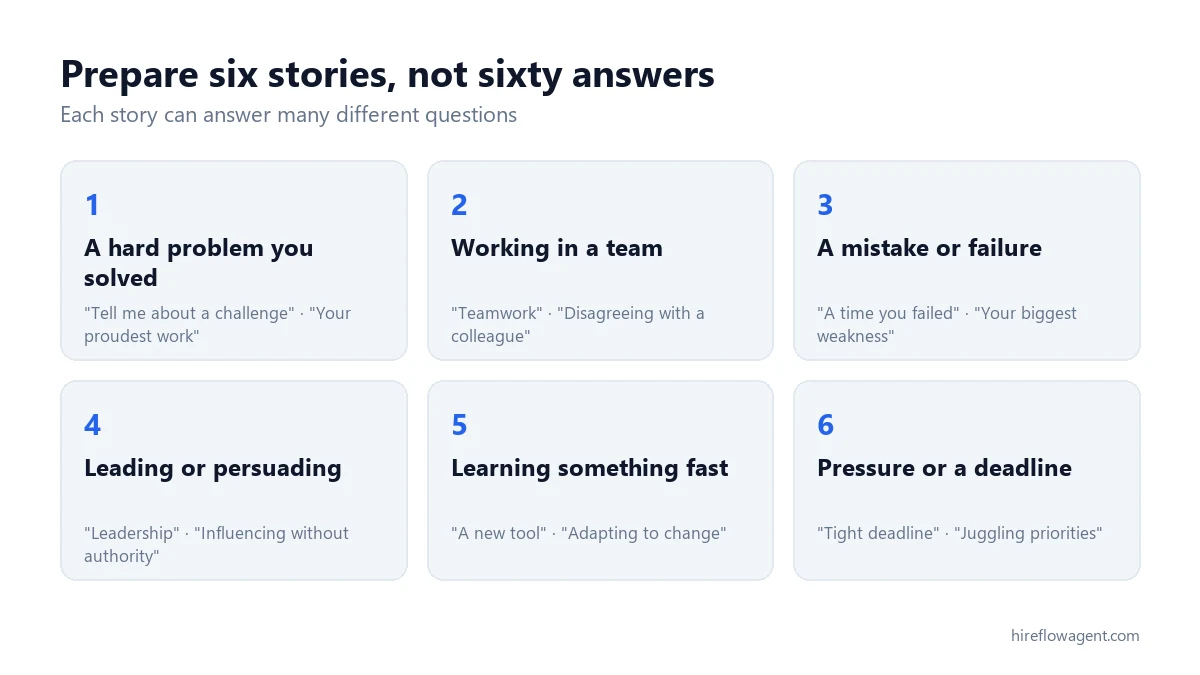
Adapting one story to different questions
Once you have a story bank, the skill is choosing the right story and emphasising the right part. Listen to what the question is really about. If it is about teamwork, spend your action section on how you worked with others. If it is about problem solving, focus on how you analysed the problem and chose a solution. The situation and result may stay almost the same; the action changes its focus.
This is also why memorised scripts fail. A story learned word for word can only answer one question. A story you know well, told from notes, can answer many.
| Question | Story to use | What to emphasise in the action |
|---|---|---|
| A time you met a tight deadline | Final-year demo moved forward | Prioritising and cutting scope |
| A time you worked in a team | Final-year demo moved forward | Daily updates and agreeing the new plan |
| How do you handle pressure? | Final-year demo moved forward | Breaking work into daily goals |
| A time you solved a difficult problem | Final-year demo moved forward | Deciding what the demo really needed |
STAR for freshers and students
If you have little work experience, STAR still works; you just draw your stories from different places. University projects, especially group and final-year projects, are rich sources, because they usually involve planning, teamwork, technical decisions and problems. Part-time jobs, volunteering, student societies and sports teams also provide excellent examples of responsibility, customer contact and working under pressure.
Interviewers hiring for entry-level roles know you will not have years of experience. What they look for is evidence of the right behaviours: taking responsibility, learning from mistakes, working with others and following things through. A well-told story from a student project shows all of these.
Practising STAR answers
Write your stories first, then practise telling them aloud, because writing and speaking are different skills. Time each one, record yourself and listen back once. Check that the action is the longest part, that you say "I" for your own actions, and that every story ends with a clear result.
Then practise in conditions closer to a real interview, where someone asks the question and follows up. Follow-up questions such as "What would you do differently?" or "Why did you choose that approach?" test whether your story holds up. An AI mock interview can ask behavioural questions and follow-ups based on your resume and the job you are applying for, then show you which answers were weakest so you can rework them.
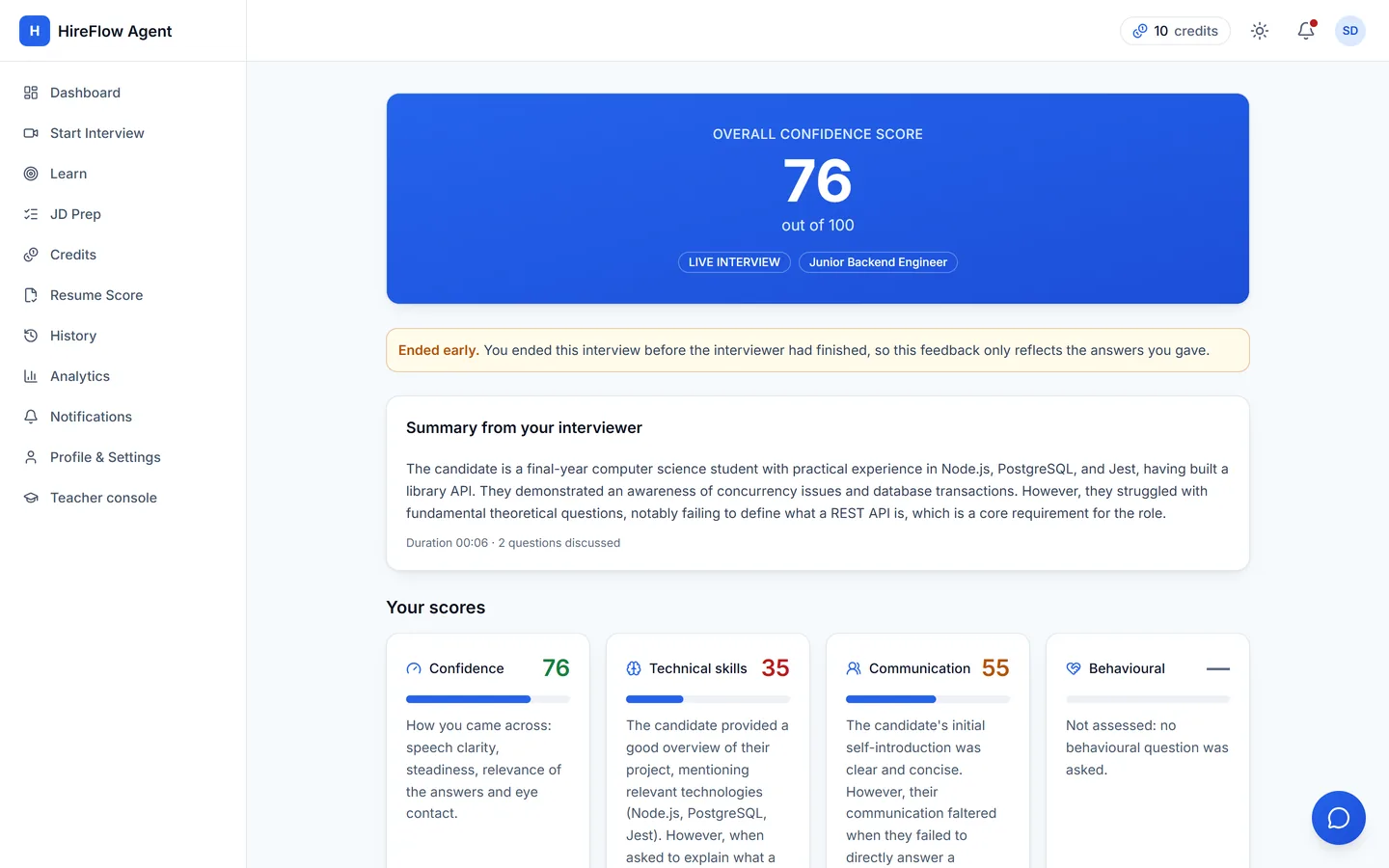
Practise this out loud
Take a live AI mock interview with questions built from your resume and the job description, then get a clear feedback report.
Start a mock interviewFrequently asked questions
- What does STAR stand for in an interview?
- Situation, Task, Action and Result: a four-part structure for telling a clear, complete story about something you did.
- How long should a STAR answer be?
- About one to two minutes, with roughly half of that spent on the actions you personally took.
- Can I use STAR if I have no work experience?
- Yes. Use stories from projects, studies, part-time jobs, volunteering or societies. The structure works the same way.
- Should I use "I" or "we" in STAR answers?
- Use "we" for the team's situation and "I" for your own actions, so the interviewer can see exactly what you contributed.
- What if my story did not have a good result?
- That can still work, especially for questions about failure. Be honest about the outcome and focus on what you learned and what you now do differently.